
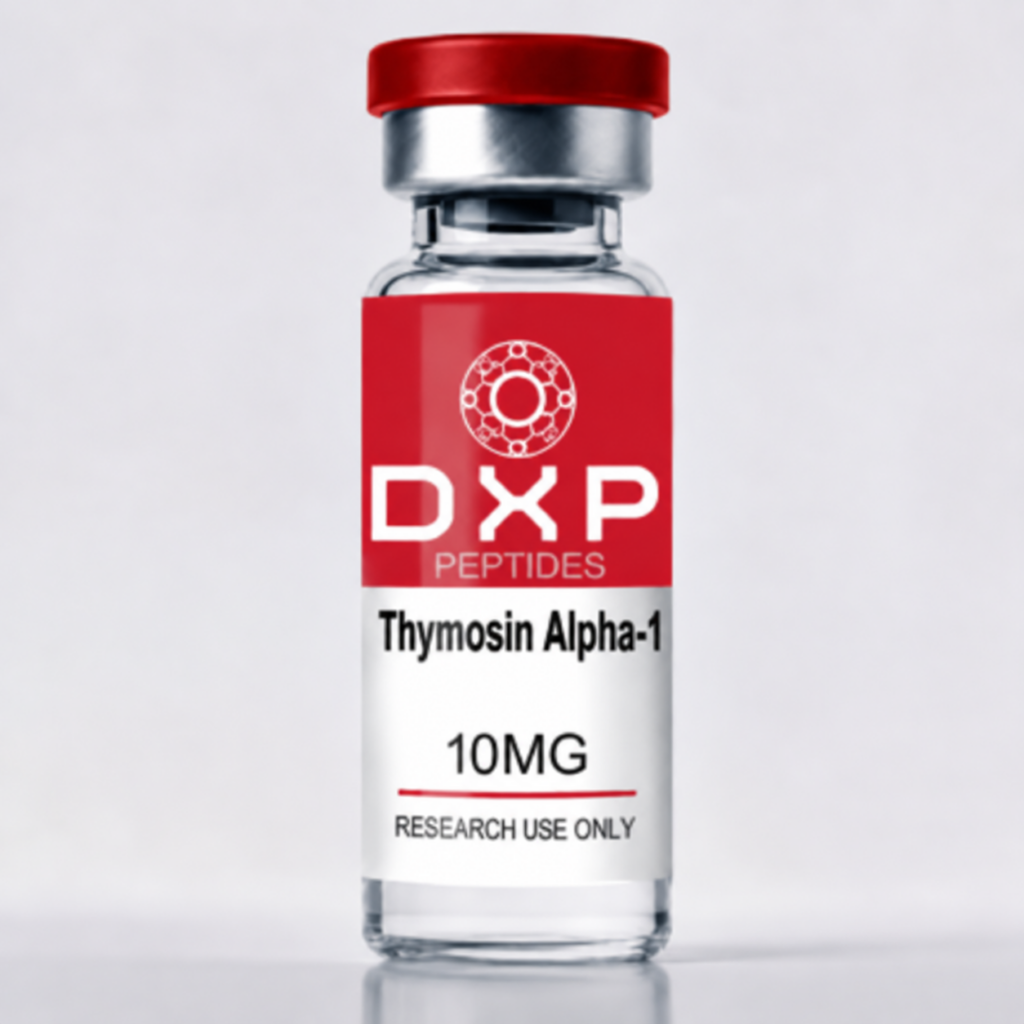
Immune Modulation & Defense
Thymosin Alpha-1
Synthetic Thymic Peptide Analogue
Research Use Only — Not For Human Consumption
Product Description
Overview
Thymosin Alpha-1 (Tα1) is a synthetic 28-amino-acid peptide that corresponds to an active fragment of prothymosin-α, an endogenous hormone naturally produced by the thymus gland. Since its isolation in the 1970s, it has become one of the most clinically validated and widely studied immune-modulating peptides in existence.
In research settings, Tα1 is utilized as a sophisticated molecular tool to investigate the bridge between innate and adaptive immunity. It is primarily studied for its ability to enhance dendritic cell maturation, T-cell differentiation (specifically the Th1 response), and Natural Killer (NK) cell activity. While clinically approved in over 35 countries (under the brand name Zadaxin) for the treatment of chronic viral hepatitis and as an oncology adjunct, it serves in the laboratory as a reference compound for exploring cytokine modulation and toll-like receptor (TLR) signaling.
Key Research Applications
Thymosin Alpha-1 is a cornerstone for immunology, inflammation, and host-defense research:
- Viral Pathogenesis: Modeling the immune response against chronic viral infections such as HBV, HCV, and HIV.
- Immunotherapy & Oncology: Investigating the enhancement of antigen presentation and NK cell activity in tumor environments.
- Cellular Differentiation: In-vitro research examining T-cell activation and the specific modulation of Th1 cytokine profiles (IL-2, IFN-α/γ).
- Intracellular Signaling: Studies involving the activation of the NF-κB pathway and toll-like receptor signaling.
- Vaccine Adjuvancy: Researching the enhancement of vaccine response and immune surveillance in immunodeficiency models.
Additional Details
- Synonyms: Tα1, Thymalfasin, Zadaxin (Brand Name)
- Sequence: Ac-SDAAVDTSSEITTKDLKEKKEVVEEAEN-OH
Handling & Reconstitution
To preserve the high-purity profile of this 28-amino-acid chain:
- Reconstitution: Use sterile water or an appropriate buffered aqueous solution.
- Technique: The peptide is hygroscopic; handle under dry conditions. Gently swirl the vial until dissolved. Avoid vigorous agitation, as this can lead to peptide denaturation.
- Stability: Aliquot the reconstituted solution into single-use portions and store at –20°C or below. This minimizes repeated freeze-thaw cycles which compromise analytical consistency.
- Sterilization: If required for cell culture, filter sterilize using a 0.22 µm membrane prior to use.
Important Safety Information
For Research Use Only. This product is a synthetic thymic peptide intended strictly for laboratory and in-vitro research applications. It is not for human or veterinary use, nor is it intended for diagnostic, therapeutic, or clinical applications. Experimental outcomes are highly dependent on immune cell type and receptor expression; therefore, appropriate controls are essential for all mechanistic investigations.
References
- Romani, L., et al. (2004). Thymosin alpha 1 activates dendritic cells for antifungal Th1 resistance. Blood, 103(11), 4232-4239.
- Goldstein A.L., Low T.L., McAdoo M., et al. Thymosin alpha1: isolation and sequence analysis of an immunologically active thymic polypeptide. Proceedings of the National Academy of Sciences USA, 1977; 74(2): 725–729. PMID: 265536. https://pubmed.ncbi.nlm.nih.gov/265536/
- Garaci E., Favalli C., Pica F., et al. Thymosin alpha 1: from bench to bedside. Annals of the New York Academy of Sciences, 2007; 1112: 225–234. PMID: 17600290. https://pubmed.ncbi.nlm.nih.gov/17600290/
- Mutchnick M.G., Appelman H.D., Chung H.T., et al. Thymosin treatment of chronic hepatitis B: a placebo-controlled pilot trial. Hepatology, 1991; 14(3): 409–415. PMID: 1874487. https://pubmed.ncbi.nlm.nih.gov/1874487/
- Romani L., Bistoni F., Montagnoli C., et al. Thymosin alpha1: an endogenous regulator of inflammation, immunity, and tolerance. Annals of the New York Academy of Sciences, 2007; 1112: 326–338. PMID: 17495242. https://pubmed.ncbi.nlm.nih.gov/17495242/
Specifications
| Molecular Formula | C129H215N33O55 |
|---|---|
| Molecular Weight | ~3108.32 g/mol |
| Purity | ≥99% (HPLC Tested) |
| Form | White to off-white lyophilized powder |
| Storage | Store desiccated at –20°C (Protect from light) |
| SKU | DEXA-THYMOSIN-ALPHA-1-1 |