
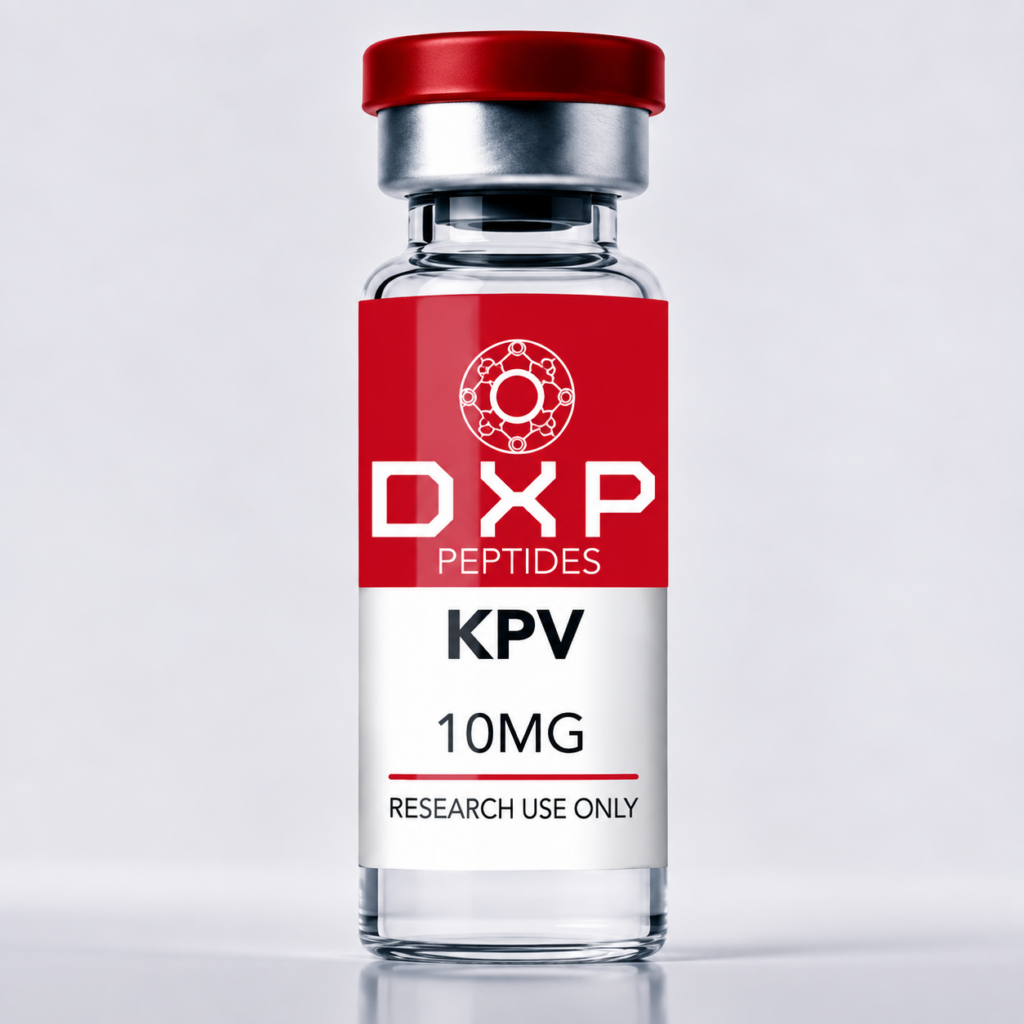
Immune Modulation & Defense
KPV
Synthetic alpha-MSH–Derived Tripeptide
Research Use Only — Not For Human Consumption
Product Description
Overview
KPV is a synthetic tripeptide consisting of the amino acids Lysine, Proline, and Valine (Lys–Pro–Val). It corresponds to the C-terminal fragment (residues 11–13) of the endogenous alpha-melanocyte-stimulating hormone (alpha-MSH). KPV is recognized in research as the minimal functional fragment of alpha-MSH required to exert potent anti-inflammatory effects.
Unlike full-length alpha-MSH or synthetic analogs like Melanotan, KPV does not induce melanogenesis (tanning) or cardiovascular side effects. Instead, it is studied for its ability to traverse cell membranes and inhibit the NF-kappaB signaling pathway, thereby reducing the production of pro-inflammatory cytokines such as IL-1beta, IL-6, and TNF-alpha. Additionally, it is investigated for its potential direct antimicrobial properties, particularly against pathogens like Staphylococcus aureus and Candida albicans.
Key Research Applications
KPV’s small molecular size and high stability make it a versatile tool in various experimental models:
- Gastrointestinal Research: Modeling the treatment of inflammatory bowel disease (IBD) and ulcerative colitis by investigating gut barrier function restoration.
- Dermatological Studies: Researching its application in acne, psoriasis, and general skin inflammation via topical and systemic models.
- Inflammatory Signaling: Investigating the inhibition of the NF-$kappa$B pathway and the modulation of cytokine cascades.
- Wound Healing: Experimental analysis of the peptide’s role in accelerating tissue repair and reducing scar formation.
- Antimicrobial Activity: In-vitro studies examining the peptide’s direct effect on fungal and bacterial cell walls.
Additional Details
- Synonyms: alpha-MSH (11–13), Lys-Pro-Val
- Sequence: Lys–Pro–Val
Handling & Reconstitution
- Reconstitution: Use sterile water or an appropriate buffered aqueous solution.
- Technique: Mix gently to dissolve the lyophilized solid. Avoid vigorous agitation, although this short tripeptide is generally more robust than longer-chain analogs.
- Storage: Once reconstituted, the solution is stable at refrigerated temperatures (2–8°C) for short-term use. For long-term stability, aliquot the solution and store at –20°C to avoid repeated freeze-thaw cycles.
Important Safety Information
For Research Use Only. This product is a synthetic tripeptide intended strictly for laboratory and in-vitro research. It is not for human or veterinary use, nor is it intended for diagnostic, therapeutic, or cosmetic applications. Researchers should note that KPV is utilized as a mechanistic signaling probe; observed outcomes are dependent on the specific biological model and concentration used.
References
- Catania A., Gatti S., Colombo G., Lipton J.M. Targeting melanocortin receptors as a novel strategy to control inflammation. Pharmacological Reviews, 2004; 56(1): 1–29. PMID: 15001661. https://pubmed.ncbi.nlm.nih.gov/15001661/
- Lipton J.M., Catania A. Anti-inflammatory actions of the neuroimmunomodulator α-MSH. Immunology Today, 1997; 18(3): 140–145. PMID: 9368769. https://pubmed.ncbi.nlm.nih.gov/9368769/
- Brzoska T., Luger T.A., Maaser C., Abels C., Böhm M. α-Melanocyte-Stimulating Hormone and Related Tripeptides: Biochemistry, Antiinflammatory and Protective Effects in Vitro and in Vivo, and Future Perspectives for the Treatment of Immune-Mediated Inflammatory Diseases. Endocrine Reviews, 2008; 29(5): 581–602. PMID: 18334621. https://pubmed.ncbi.nlm.nih.gov/18334621/
- Hruby V.J., Cai M., Grieco P., et al. Exploring the stereostructural requirements of peptide ligands for the melanocortin receptors. Annals of the New York Academy of Sciences, 2003; 994: 12–20. PMID: 12851295. https://pubmed.ncbi.nlm.nih.gov/12851295/
- Getting S.J., Gibbs L., Clark A.J.L., Flower R.J., Perretti M. POMC gene-derived peptides activate melanocortin type 3 receptor on murine macrophages, suppress cytokine release, and inhibit neutrophil migration in acute experimental inflammation. Journal of Immunology, 2002; 168(9): 4617–4627. PMID: 12421969. https://pubmed.ncbi.nlm.nih.gov/12421969/
- Patel H.B., Bombardieri M., Sampaio A.L.F., et al. Anti-inflammatory and antiosteoclastogenesis properties of endogenous melanocortin receptor type 3 in experimental arthritis. FASEB Journal, 2010; 24(12): 4835–4843. PMID: 20667976. https://pubmed.ncbi.nlm.nih.gov/20667976/
- PubChem. Lys–Pro–Val (KPV) peptide compound summary. https://pubchem.ncbi.nlm.nih.gov/compound/Lys-Pro-Val
Specifications
| Molecular Formula | \(C_{16}H_{30}N_{4}O_{4}\) |
|---|---|
| Molecular Weight | ~342.43 g/mol |
| Purity | ≥98–99% (HPLC Tested) |
| Form | White to off-white lyophilized powder |
| Storage | Store at –20°C (Long-term); 2–8°C (Post-reconstitution) |
| SKU | DEXA-KPV-1 |