
Neuroprotection & Cognitive Function
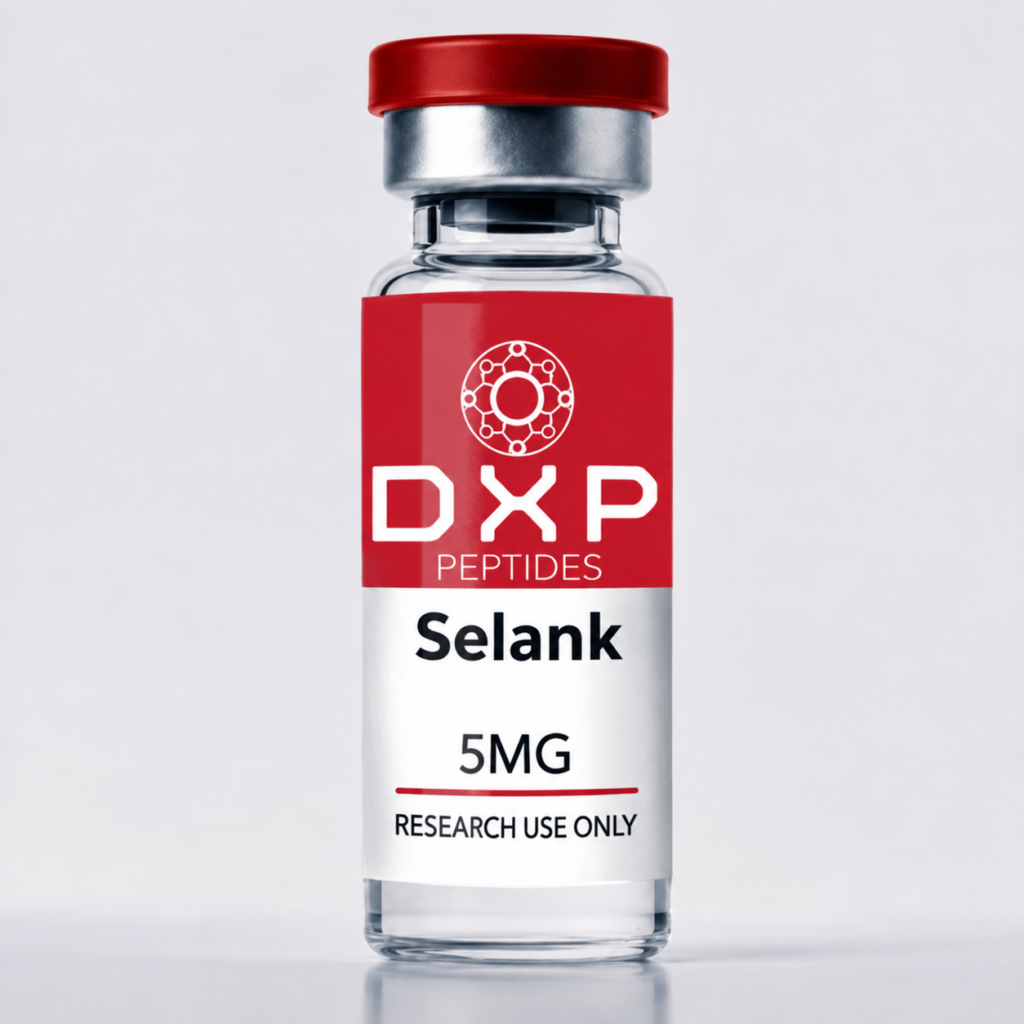
Selank
Synthetic Neuropeptide & Tuftsin Analogue
Research Use Only — Not For Human Consumption
Product Description
Overview
Selank is a synthetic heptapeptide derived from the endogenous immunomodulatory tetrapeptide, Tuftsin. By incorporating a Gly-Pro C-terminal modification, Selank offers significantly improved metabolic stability and resistance to enzymatic degradation compared to its natural counterpart.
Developed and clinically approved in Russia for the management of generalized anxiety disorder, Selank is a primary subject of interest in neuroimmune research. It is widely recognized for its unique anxiolytic properties which, in research models, appear to function without the sedative or cognitive-impairing effects typical of traditional GABAergic compounds. It serves as a sophisticated molecular probe for studying the modulation of serotonin metabolism, BDNF upregulation, and the reduction of neuroinflammatory markers.
Key Research Applications
Selank is frequently utilized in neurobiology to investigate the intersection of the immune system and the CNS:
- Neuroimmune Signaling: Modeling the interactions between immunomodulatory peptides and central nervous system regulatory pathways.
- Anxiety & Stress Resilience: Researching non-sedative anxiolytic pathways and the modulation of GABA-A receptor function.
- Neurotransmitter Metabolism: Analysis of the peptide’s influence on serotonin and dopamine signaling cascades.
- Synergistic Research: Often studied alongside Semax in dual-peptide protocols to investigate the balance between calm focus (Selank) and active cognitive enhancement (Semax).
- Gene Expression: Investigating changes in neuronal cell systems and the expression of neurotrophic factors like BDNF.
Additional Details
- Sequence: Thr–Lys–Pro–Arg–Pro–Gly–Pro
- Peptide Type: Synthetic Heptapeptide Analogue
Handling & Reconstitution
To maintain the structural integrity of the Thr–Lys–Pro–Arg–Pro–Gly–Pro sequence:
- Reconstitution: Use sterile water or a buffered aqueous solution.
- Technique: This peptide is hygroscopic; handle under dry conditions. Gently swirl until dissolved; avoid vigorous agitation to prevent denaturation.
- Stability: Aliquot reconstituted solutions and store at –20°C or below. Avoid repeated freeze-thaw cycles and prepare fresh working solutions when possible for experimental consistency.
Important Safety Information
For Research Use Only. This product is intended strictly for laboratory and in-vitro research. While utilized clinically in specific regions for anxiety and mood stabilization, it is not for human or veterinary consumption. All experimental outcomes are dependent on the model system and must be conducted using appropriate laboratory safety procedures.
References
- Ashmarin, I. P., et al. (2005). Regulatory neuropeptides in central nervous system function. Neuroscience and Behavioral Physiology, 35(5), 501-506. PubMed
- Myasoedov, N. F., et al. (2001). Tuftsin-derived peptides and neuroimmune regulation. Journal of Peptide Science, 7(7), 351-357. PubMed
- Zozulya, A. A., et al. (2010). Neuropeptide Selank and stress-related signalling. Bulletin of Experimental Biology and Medicine, 149(1), 30-33. PubMed
Specifications
| Molecular Formula | C33H57N11O6 |
|---|---|
| Molecular Weight | ~751.9 g/mol |
| Purity | ≥99% (HPLC Tested) |
| Form | White to off-white lyophilized powder |
| Storage | Store desiccated at –20°C (Protect from light) |
| SKU | DEXA-SELANK |