
Neuroprotection & Cognitive Function
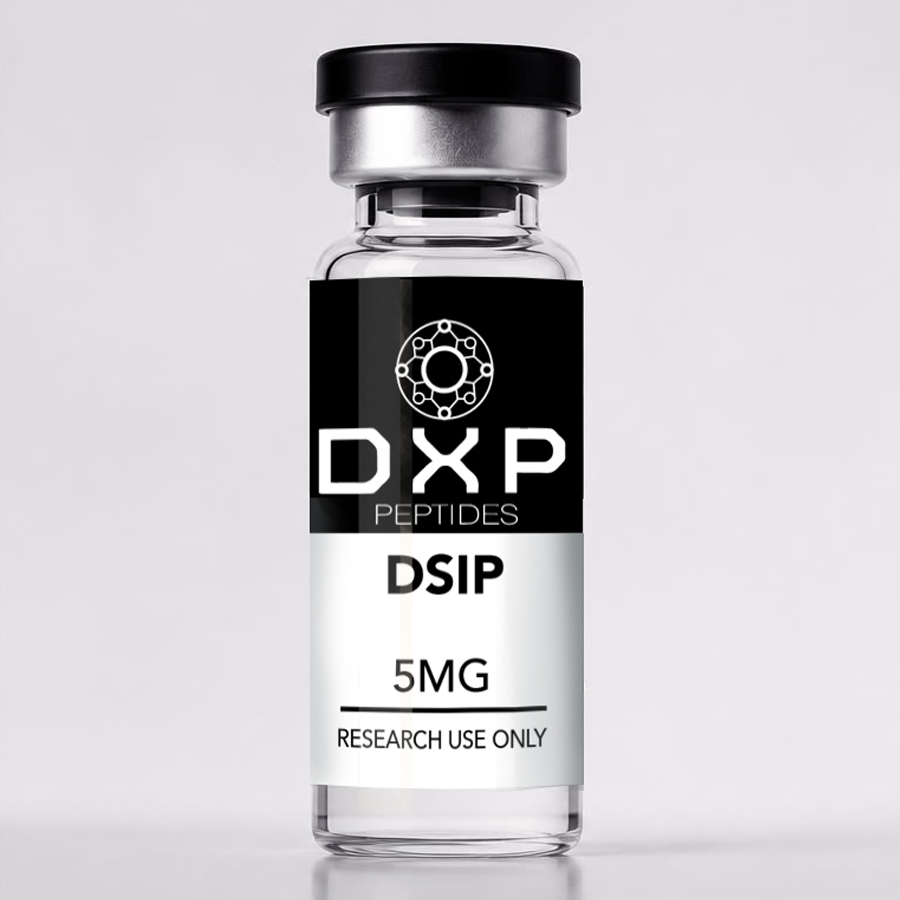
DSIP
Research-Grade Synthetic Delta Sleep–Inducing Peptide
Research Use Only — Not For Human Consumption
Product Description
Overview
DSIP (Delta Sleep–Inducing Peptide) is a synthetic nonapeptide (Trp-Ala-Gly-Gly-Asp-Ala-Ser-Gly-Glu) originally isolated from cerebral venous blood in the 1970s. As a naturally occurring neuropeptide, it has become a staple in neurochemical research for its unique role in investigating sleep-related brain activity and neuroendocrine regulation.
In experimental models, DSIP is primarily studied for its ability to promote slow-wave (delta) sleep and modulate the release of stress-associated hormones, such as ACTH and cortisol. Its research applications are broad, ranging from the normalization of circadian rhythms to investigating neuroendocrine balance in chronic fatigue and withdrawal models. Because its effects are highly context-dependent and dose-sensitive, it remains a critical molecular probe for understanding the nuances of the central nervous system.
Key Research Applications
DSIP is utilized as a specialized tool in mechanistic neuroscience to study:
- Sleep Architecture: Investigation of neuropeptide signaling associated with delta-wave sleep induction.
- Stress-Response Modulation: Researching the interaction between neuropeptides and the HPA axis, specifically regarding ACTH and cortisol regulation.
- Neuroendocrine Pathways: Analysis of receptor-associated intracellular cascades, including NMDA-linked and MAPK-associated mechanisms.
- Withdrawal Models: Experimental studies exploring the peptide’s role in opioid and alcohol withdrawal research.
- Circadian Biology: Modeling the stabilization of circadian rhythms and neuroendocrine balance under various environmental stressors.
Additional Details
- Sequence: Trp-Ala-Gly-Gly-Asp-Ala-Ser-Gly-Glu
- Peptide Type: Synthetic Nonapeptide
Handling & Reconstitution
DSIP is a hygroscopic peptide and requires precise handling to ensure experimental consistency:
- Reconstitution: Use sterile water, phosphate-buffered saline (PBS), or dilute acetic acid, depending on the specific assay requirements.
- Technique: Gently swirl the vial until the powder is fully dissolved. Avoid vigorous agitation, as the peptide can be sensitive to mechanical stress.
- Stability: DSIP has been reported to be unstable in certain systems; it is highly recommended to prepare fresh working solutions and aliquot any remaining material for storage at –20°C or below.
- Sterilization: Filter sterilize (0.22 µm) if required for in-vitro use.
Important Safety Information
For Research Use Only. This product is a synthetic neuropeptide intended strictly for laboratory and in-vitro research applications. It is not for human or veterinary use. Observed experimental responses vary significantly based on model systems and enzymatic stability; therefore, the use of appropriate negative and vehicle controls is strongly recommended.
References
- Bocheva, A., et al. (2021). DSIP and its analogues: potential neuroprotective research applications. Molecules, 26(17), 5173. MDPI
- Kovalzon, V. M., & Strekalova, T. V. (2006). Delta sleep-inducing peptide (DSIP): a still unresolved riddle. Journal of Neurochemistry, 87(2), 303-313. PubMed
- Schneider-Helmert, D., & Schoenenberger, G. A. (1983). Effects of DSIP in man. Multifunctional effects of a neuropeptide. Neuropsychobiology, 9(2-3), 101-106. PubMed
- Longevity, Anti-Aging & Cellular Health
- Peptide
- Consolidated Research Description
Specifications
| Molecular Formula | \(C_{35}H_{48}N_{10}O_{15}\) |
|---|---|
| Molecular Weight | ~848.82 g/mol |
| Purity | ≥99% (HPLC Tested) |
| Form | White to off-white lyophilized powder |
| Storage | Store desiccated at –20°C (Protect from light) |
| SKU | DEXA-DSIP |