
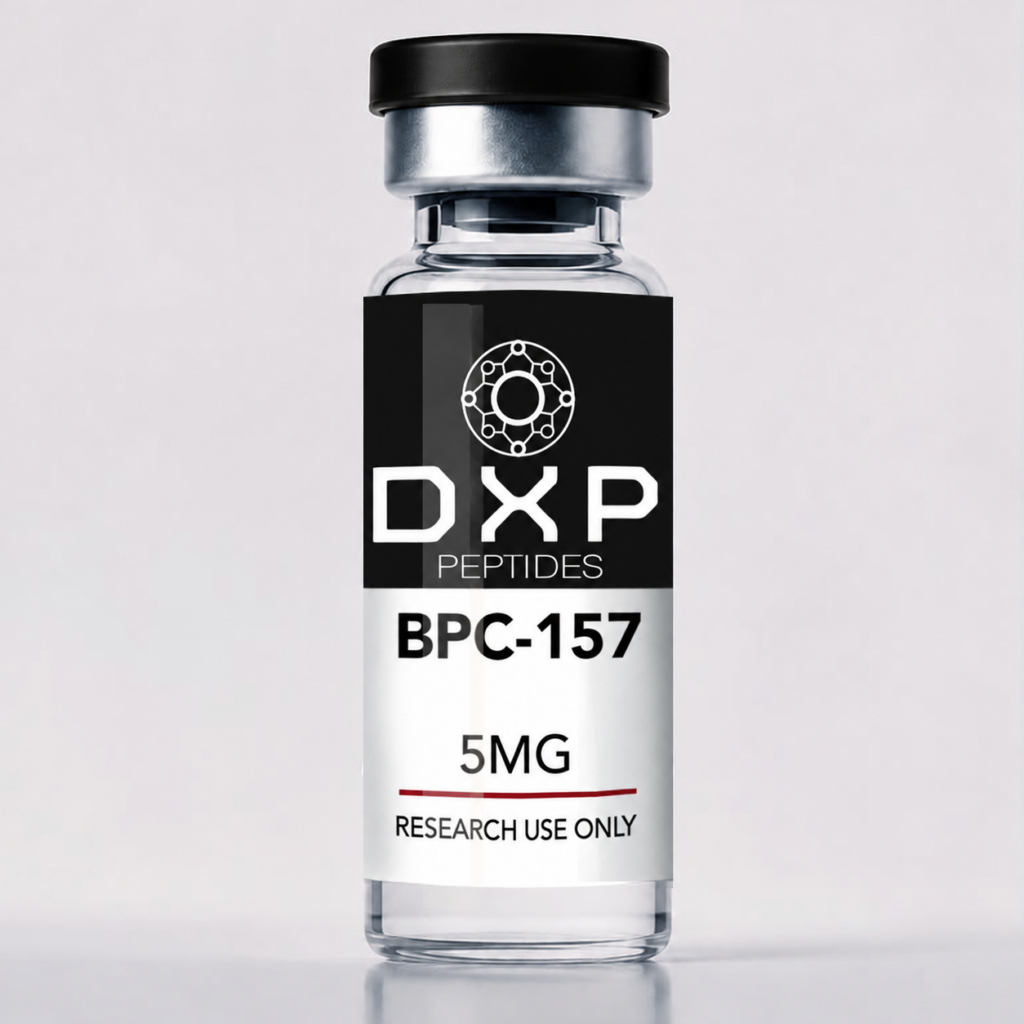
Tissue Repair & Recovery
BPC-157
Synthetic Gastric-Derived Pentadecapeptide
Research Use Only — Not For Human Consumption
Product Description
Overview
BPC-157 (Body Protection Compound-157) is a synthetic 15-amino-acid peptide Gly-Glu-Pro-Pro-Pro-Gly-Lys-Pro-Ala-Asp-Asp-Ala-Gly-Leu-Val derived from a naturally occurring protective protein found in human gastric juice. It is uniquely characterized by its extreme stability in harsh environments, such as gastric acid, which distinguishes it from the majority of other peptides.
In regenerative medicine research, BPC-157 is one of the most extensively documented compounds, with over 100 preclinical studies exploring its role in multi-tissue repair. It is a primary molecular probe for investigating the healing of tendons, ligaments, skeletal muscle, and bone. Its mechanism of action is thought to involve the modulation of the nitric oxide system, the upregulation of vascular endothelial growth factor (VEGF) to promote angiogenesis, and the activation of the FAK-paxillin pathway, which is essential for cell migration and tissue remodeling.
Key Research Applications
BPC-157 is utilized in diverse experimental models focusing on structural and systemic repair:
- Musculoskeletal Healing: Researching the acceleration of tendon-to-bone healing and the repair of ruptured ligaments and muscles.
- Gastrointestinal Protection: Modeling the restoration of gut mucosa integrity and the protection of the digestive tract from chemical or NSAID-induced damage.
- Angiogenesis & Nitric Oxide: Investigating the modulation of VEGF pathways and nitric oxide-associated signaling to enhance blood flow and nutrient delivery to damaged tissues.
- Dermatological & Ocular Research: Studies examining the healing of skin burns, surgical incisions, and corneal injuries.
- Neuroprotection: Experimental research exploring the peptide’s influence on the dopaminergic system and its potential neuroprotective effects following injury.
Additional Details
- Synonyms: Body Protection Compound-157, PL-14736
- Sequence: Gly-Glu-Pro-Pro-Pro-Gly-Lys-Pro-Ala-Asp-Asp-Ala-Gly-Leu-Val
Handling & Reconstitution
To maintain the analytical integrity of this pentadecapeptide:
- Reconstitution: Use sterile water or an appropriate buffered aqueous solution.
- Technique: The peptide is hygroscopic; handle under dry conditions. Gently swirl until fully dissolved. Avoid vigorous agitation, as this can compromise the peptide’s stability.
- Stability: Aliquot the reconstituted solution into single-use portions and store at –20°C. Avoid repeated freeze-thaw cycles, which can lead to precipitation or degradation.
- Sterilization: If required for in-vitro or ex-vivo assays, filter sterilize (0.22 µm) before use.
Important Safety Information
For Research Use Only. This product is a synthetic peptide intended strictly for laboratory research and is not for human or veterinary use. While preclinical data is extensive, there are currently no completed human clinical trials. All reported pathway interactions are context-dependent and require appropriate experimental controls for accurate interpretation.
References
- Sikiric P., Seiwerth S., Rucman R., et al. Stable gastric pentadecapeptide BPC 157: novel therapy in gastrointestinal tract. Current Pharmaceutical Design, 2011; 17(16): 1612–1632. PMID: 21548867. https://pubmed.ncbi.nlm.nih.gov/21548867/
- Hsieh M.J., Liu H.T., Wang C.N., et al. Therapeutic potential of pro-angiogenic BPC157 is associated with VEGFR2 activation and up-regulation. Journal of Molecular Medicine, 2017; 95(3): 323–333. PMID: 27847966. https://pubmed.ncbi.nlm.nih.gov/27847966/
- Brcic L., Brcic I., Staresinic M., Novinscak T., Sikiric P., Seiwerth S. Modulatory effect of gastric pentadecapeptide BPC 157 on angiogenesis in muscle and tendon healing. Journal of Physiology and Pharmacology, 2009; 60(Suppl 7): 191–196. https://pubmed.ncbi.nlm.nih.gov/19258669/
- Józwiak M., Bauer M., Kamysz W., Kleczkowska P. Multifunctionality and possible medical application of the BPC 157 peptide — literature and patent review. Pharmaceuticals, 2025; 18(2): 185. https://www.mdpi.com/1424-8247/18/2/185
- Chang C.H., Tsai W.C., Hsu Y.H., Pang J.H.S. Pentadecapeptide BPC 157 enhances the growth hormone receptor expression in tendon fibroblasts. Molecules, 2014; 19(11): 19066–19077. PMID: 25415472. https://pubmed.ncbi.nlm.nih.gov/25415472/
- Vasireddi N., Hahamyan H., Salata M.J., et al. Emerging use of BPC-157 in orthopaedic sports medicine: a systematic review. HSS Journal, 2025. https://pmc.ncbi.nlm.nih.gov/articles/PMC12313605/
Specifications
| Molecular Formula | C62H98N16O22 |
|---|---|
| Molecular Weight | ~1479.6 g/mol |
| Purity | ≥99% (HPLC Tested) |
| Form | White to off-white lyophilized powder |
| Storage | Store desiccated at –20°C (Protect from light) |
| SKU | DEXA-BPC-157 |