
Longevity, Anti-Aging & Cellular Health
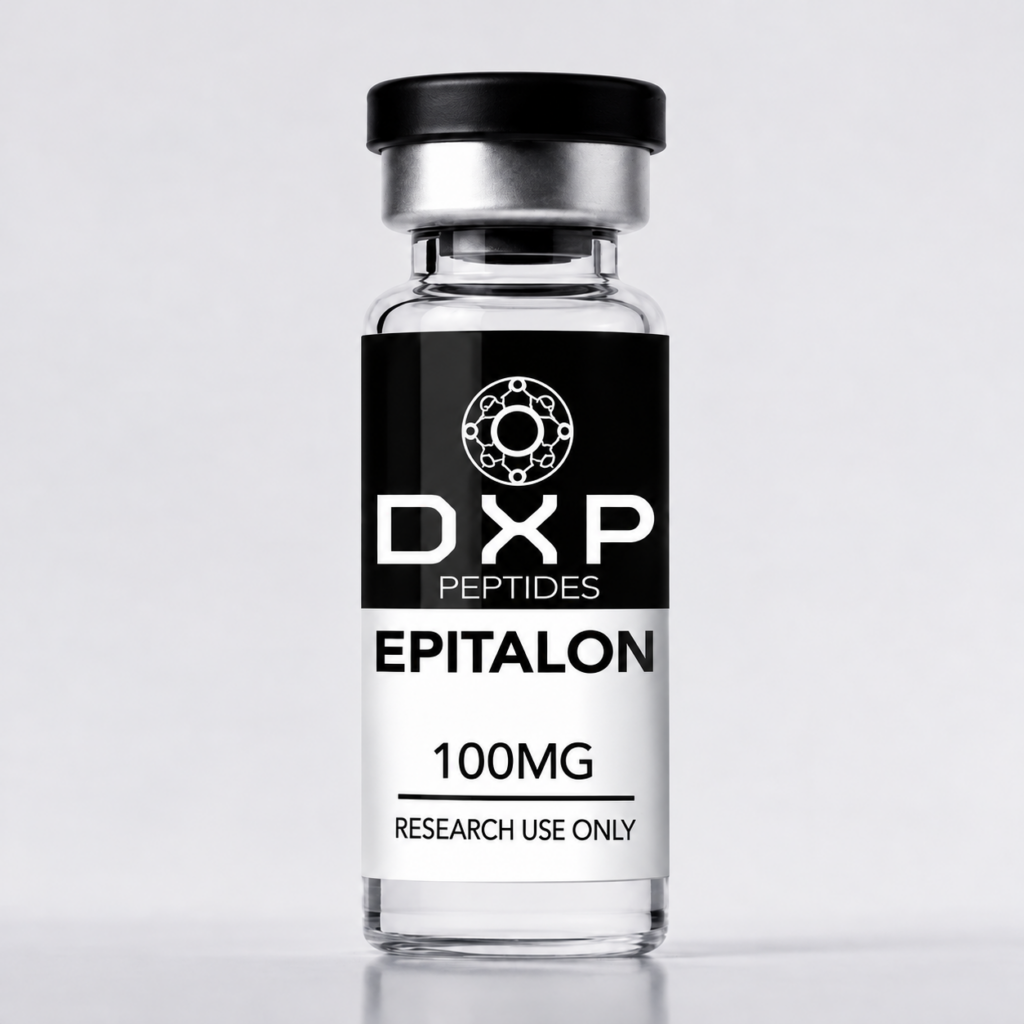
Epitalon
Research-Grade Synthetic Pineal-Derived Tetrapeptide
Research Use Only — Not For Human Consumption
Product Description
Overview
Epithalon (also known as Epitalon) is a synthetic tetrapeptide consisting of the amino acid sequence Ala–Glu–Asp–Gly. It was originally characterized as the active fragment of epithalamin, a natural peptide preparation derived from the pineal gland, developed during the extensive research at the St. Petersburg Institute of Bioregulation and Gerontology.
In molecular biology and gerontology research, Epithalon is most recognized for its role in investigating telomerase activation. It serves as a primary model compound for studying telomere maintenance, the reversal of cellular senescence, and the restoration of pineal gland function. Because of its simple structure and high stability, it is widely utilized to observe direct gene activation and the normalization of circadian rhythms and neuroendocrine signaling in aging models.
Key Research Applications
Epithalon is a cornerstone of research into the molecular mechanisms of biological aging:
- Telomere Maintenance: Investigating the induction of telomerase activity and the extension of telomeric repeats in cellular models.
- Gene Regulation: Researching short peptide-mediated interactions within chromatin and nuclear signaling pathways.
- Circadian Biology: Analysis of the peptide’s influence on melatonin secretion and the normalization of sleep-wake cycles.
- Neuroendocrine Research: Modeling the restoration of endocrine function and investigating age-related physiological decline.
- Transcriptional Regulation: In-vitro studies examining the impact of Ala–Glu–Asp–Gly on gene expression profiles and protein synthesis.
Additional Details
- Synonyms: Epitalon, Epithalamin-derived tetrapeptide
- Sequence: Ala–Glu–Asp–Gly
Handling & Reconstitution
To ensure the analytical reliability of this pineal-derived analogue:
- Reconstitution: Use sterile water or an appropriate buffered aqueous solution.
- Technique: Gently swirl the vial until the powder is fully dissolved. Avoid vigorous agitation, as excessive mechanical force can affect peptide integrity.
- Storage: After reconstitution, the solution should be kept refrigerated. It is highly recommended to aliquot the solution to minimize repeated freeze-thaw cycles, which can degrade the peptide over time.
Important Safety Information
For Research Use Only. This product is a synthetic tetrapeptide intended strictly for laboratory and in-vitro research. It is not for human or veterinary consumption, nor is it intended for diagnostic, therapeutic, or clinical applications. All procedures must be conducted by qualified personnel using appropriate laboratory safety protocols and research-grade quality controls.
References
- Anisimov, V. N., et al. (2024). Epitalon increases telomere length in somatic cells. Advances in Gerontology. PMC12411320
- Khavinson, V. Kh., et al. (2003). Epithalon peptide induces telomerase activity and telomere elongation in human somatic cells. Bulletin of Experimental Biology and Medicine, 135(6), 590-592. PubMed
- St. Petersburg Institute of Bioregulation. Overview of Epitalon peptide research and mechanisms. PMC1143447
Specifications
| Molecular Formula | \(C_{14}H_{22}N_{4}O_{9}\) |
|---|---|
| Molecular Weight | ~390.35 g/mol |
| Purity | ≥98–99% (HPLC Tested) |
| Form | White to off-white lyophilized powder |
| Storage | Store at –20°C (Long-term); 2–8°C (Post-reconstitution) |
| SKU | DEXA-EPITALON-1 |