
Sexual Health & Reproductive Function
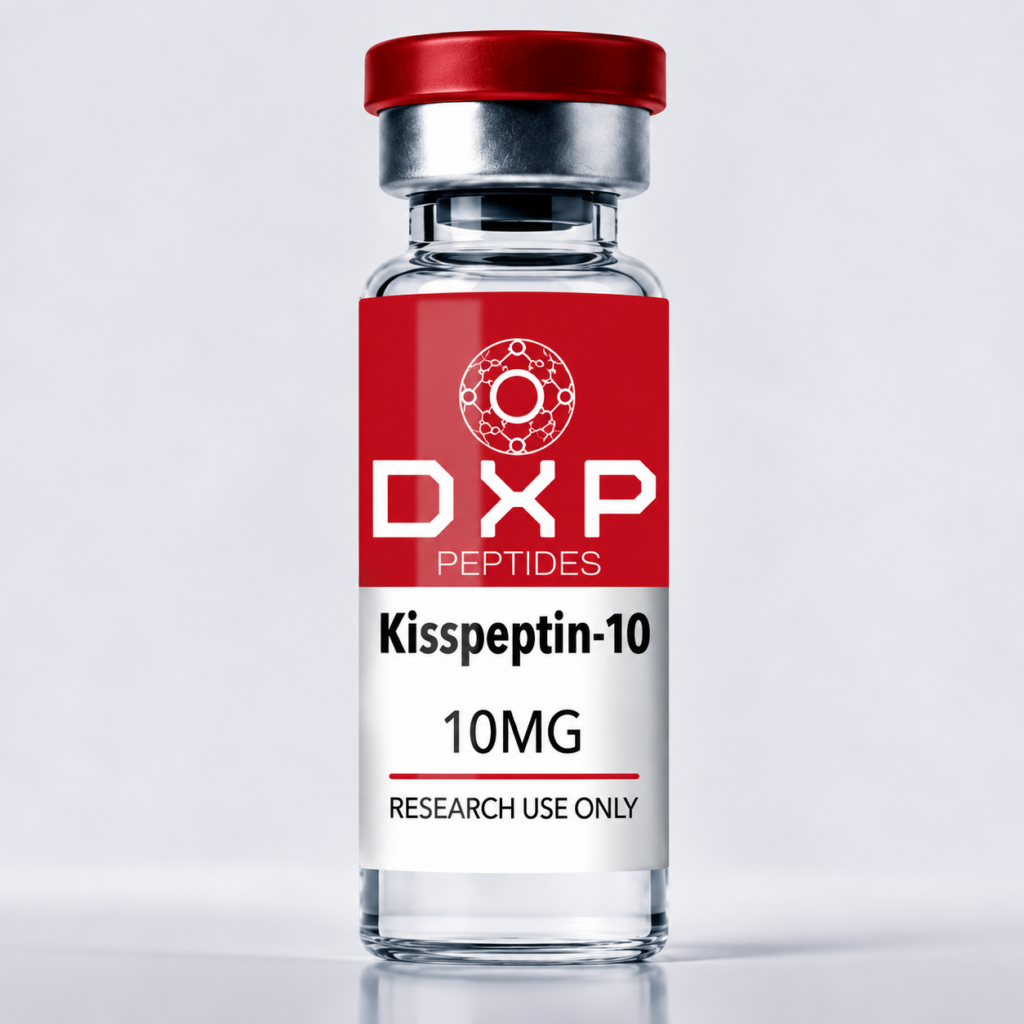
Kisspeptin-10
Synthetic Neuroendocrine Peptide (KiSS1-Derived Decapeptide)
Research Use Only — Not For Human Consumption
Product Description
Overview
Kisspeptin-10 is a synthetic decapeptide representing the C-terminal active fragment of the KiSS-1 gene product. In neuroendocrinology, Kisspeptin is recognized as the “master regulator” of reproductive function, acting as the primary trigger for the activation of Gonadotropin-Releasing Hormone (GnRH) neurons.
In research environments, Kisspeptin-10 is used to investigate the high-affinity binding and activation of the KISS1 receptor (GPR54), a G-protein-coupled receptor located in the hypothalamus. By stimulating this receptor, the peptide initiates a signaling cascade that governs the Hypothalamic-Pituitary-Gonadal (HPG) axis, leading to the secretion of Luteinizing Hormone (LH) and Follicle-Stimulating Hormone (FSH). Its short half-life (measured in minutes) makes it an ideal tool for studying acute neuroendocrine responses and assessing the integrity of reproductive signaling pathways.
Key Research Applications
Kisspeptin-10 is a critical probe for reproductive endocrinology and developmental biology:
- GnRH Neuron Activation: Investigating the upstream mechanisms that trigger the onset of puberty and maintain reproductive cycle regularity.
- HPG Axis Modeling: Researching the regulation of LH and FSH secretion in models of hypogonadism and Polycystic Ovary Syndrome (PCOS).
- Fertility Research: Studies examining the peptide’s role in egg maturation, ovulation, and spermatogenesis.
- GPR54 Receptor Dynamics: Analysis of ligand-receptor binding affinity and intracellular signaling cascades (e.g., Phospholipase C activation).
- Diagnostic Modeling: Used in clinical research settings to test the functional capacity of the pituitary gland and hypothalamus.
Additional Details
- Synonyms: Metastin (45-54), KiSS1-derived decapeptide
- Sequence: YN-WNSFGLRF-$NH_2$ (C-terminal fragment)
Handling & Reconstitution
To preserve the bioactivity of this 10-amino-acid fragment:
- Reconstitution: Use sterile water or an appropriate buffered aqueous solution.
- Technique: Add the diluent gently and allow the lyophilized solid to dissolve completely. Avoid vigorous agitation, as the peptide’s structural integrity is essential for receptor binding.
- Stability: Due to its short half-life and susceptibility to degradation, reconstituted solutions should be aliquoted and stored at 2–8°C for immediate use or frozen at –20°C for long-term stability. Avoid repeated freeze-thaw cycles.
Important Safety Information
For Research Use Only. This product is a synthetic neuroendocrine peptide intended strictly for laboratory and in-vitro research. It is not for human or veterinary use, nor is it intended for diagnostic, therapeutic, or cosmetic applications. Researchers should note that experimental outcomes are highly sensitive to the model system’s metabolic and hormonal state. Standard laboratory safety procedures must be followed during handling.
References
- Kotani M. et al. The metastasis suppressor gene KiSS-1 encodes kisspeptins, the natural ligands of the orphan G protein-coupled receptor GPR54. Journal of Biological Chemistry, 2001. https://pubmed.ncbi.nlm.nih.gov/11457843/
- Seminara S.B. et al. The GPR54 gene as a regulator of puberty. New England Journal of Medicine, 2003. https://pubmed.ncbi.nlm.nih.gov/14573733/
- Dhillo W.S. et al. Kisspeptin-54 stimulates the hypothalamic-pituitary-gonadal axis in human males. Journal of Clinical Endocrinology & Metabolism, 2005. https://pubmed.ncbi.nlm.nih.gov/16174713/
- Pinilla L. et al. Kisspeptins and reproduction: physiological roles and regulatory mechanisms. Physiological Reviews, 2012. https://pubmed.ncbi.nlm.nih.gov/22396373/
Specifications
| Molecular Formula | C63H83N17O14 |
|---|---|
| Molecular Weight | ~1302.4 g/mol |
| Purity | ≥98–99% (HPLC Tested) |
| Form | White to off-white lyophilized powder |
| Storage | Store at –20°C (Long-term); 2–8°C (Post-reconstitution) |
| SKU | DEXA-KISSPEPTIN-10 |