
Immune Modulation & Defense
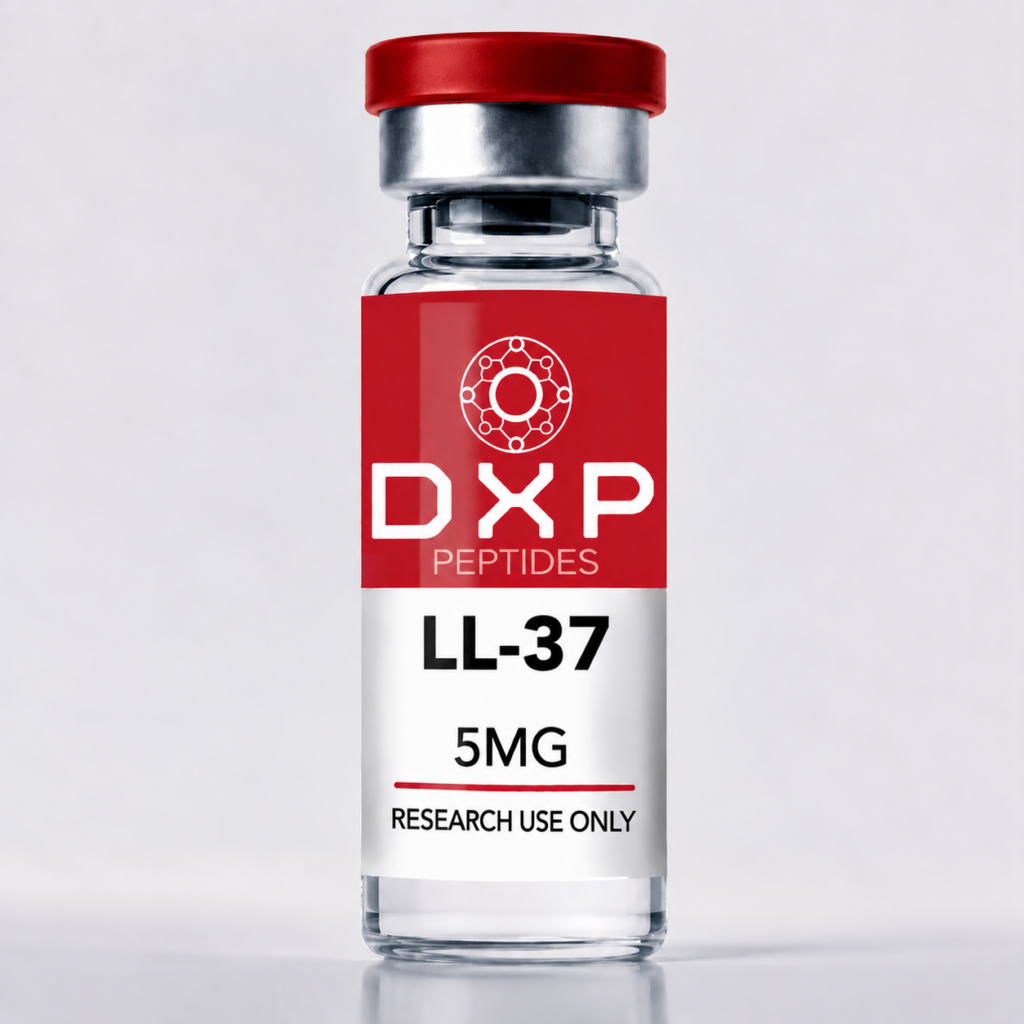
LL-37
Synthetic Human Cathelicidin Antimicrobial Peptide
Research Use Only — Not For Human Consumption
Product Description
Overview
LL-37 is a 37-amino-acid cationic, $alpha$-helical peptide and the only member of the cathelicidin family found in humans. Derived from the C-terminal region of the hCAP-18 precursor, it serves as a critical component of the innate immune system.
In research environments, LL-37 is highly valued for its multi-functional role as a host-defense peptide. It is studied not only for its broad-spectrum antimicrobial activity—targeting gram-positive and gram-negative bacteria, fungi, and enveloped viruses—but also for its ability to disrupt established biofilms. Beyond direct pathogen neutralization, LL-37 is a key molecular probe for investigating immunomodulatory pathways, including chemotaxis, cellular migration, and the modulation of cytokine and chemokine expression.
Key Research Applications
LL-37 is a cornerstone of research into innate immunity and infection control:
- Antimicrobial Mechanisms: Investigating peptide–membrane interactions and the disruption of microbial cell walls.
- Infection and Biofilms: Modeling the neutralization of pathogens and the disruption of multi-species biofilms.
- Wound Healing & Dermatology: Researching the peptide’s role in chronic wound models and inflammatory skin conditions such as rosacea and psoriasis.
- Immunomodulation: Cellular assays focused on inflammatory signaling, cytokine regulation, and host-defense signaling.
- Pulmonary Research: Studies investigating the activity of LL-37 in cystic fibrosis lung disease models and airway inflammation.
Additional Details
- Synonyms: CAP-18 Fragment, hCAP-18 (104-140)
- Peptide Type: Synthetic Cathelicidin-derived Peptide
Handling & Reconstitution
To maintain the structural integrity of this 37-amino-acid alpha-helix:
- Reconstitution: Use sterile water or an appropriate buffered aqueous solution.
- Technique: Gently swirl the vial until the powder is fully dissolved. Avoid vigorous agitation, as this can lead to peptide denaturation or aggregation.
- Stability: Aliquot reconstituted solutions to minimize repeated freeze-thaw cycles. Store frozen for long-term stability and protect from light.
- Sterilization: If required for cell culture or in-vitro assays, filter sterilize (0.22 µm) before experimental use.
Important Safety Information
For Research Use Only. This product is a synthetic representation of the human cathelicidin peptide intended strictly for laboratory and in-vitro research applications. It is not for human or veterinary use, nor is it intended for diagnostic, therapeutic, or cosmetic applications. Researchers should note that molecular responses are highly dependent on concentration and the specific experimental model utilized.
References
- Vandamme D., Landuyt B., Luyten W., Schoofs L. A comprehensive summary of LL-37, the factotum human cathelicidin peptide. Cellular Immunology, 2012; 280(1): 22–35. PMID: 23246832. https://pubmed.ncbi.nlm.nih.gov/23246832/
- Kahlenberg J.M., Kaplan M.J. Little peptide, big effects: the role of LL-37 in inflammation and autoimmune disease. The Journal of Immunology, 2013; 191(10): 4895–4901. PMID: 24127553. https://pubmed.ncbi.nlm.nih.gov/24127553/
Specifications
| Molecular Formula | C205H340N60O53 |
|---|---|
| Molecular Weight | 4493.33 g/mol |
| Purity | ≥98% (HPLC Tested) |
| Form | White to off-white lyophilized powder |
| Storage | Store at −20°C, protected from light and moisture |
| SKU | DEXA-LL-37 |