
Neuroprotection & Cognitive Function
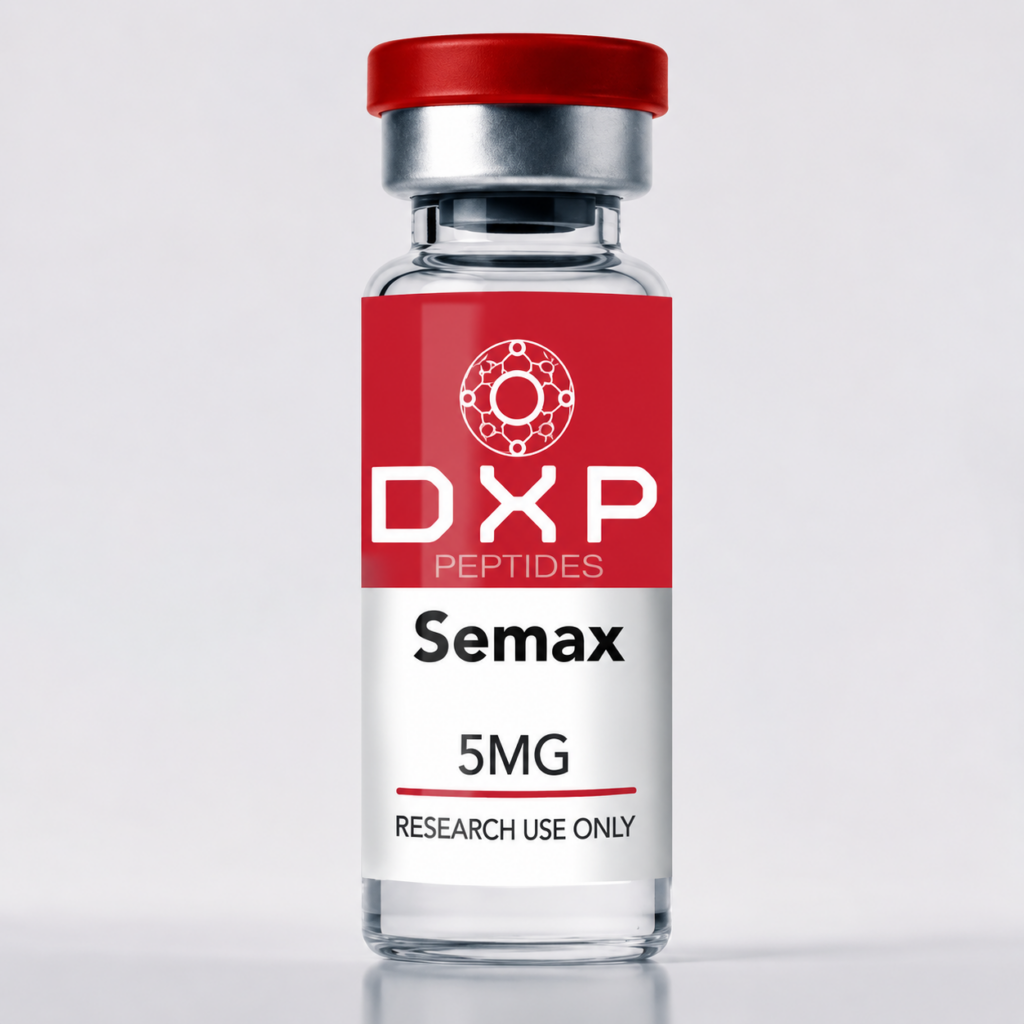
Semax
Research-Grade Synthetic ACTH-Derived Neuropeptide
Research Use Only — Not For Human Consumption
Product Description
Overview
Semax is a synthetic heptapeptide analogue of the adrenocorticotropic hormone fragment ACTH(4–10). Specifically modified with a Pro–Gly–Pro C-terminal extension, this structure is designed for enhanced resistance to enzymatic degradation and superior penetration within central nervous system (CNS) pathways.
Originally developed at the Institute of Molecular Genetics in Moscow, Semax is one of the most rigorously studied nootropic peptides. In research models, it is used to investigate the upregulation of Brain-Derived Neurotrophic Factor (BDNF) and Nerve Growth Factor (NGF). It is widely recognized for its potential to modulate dopaminergic and serotonergic systems, making it a primary tool for studying neuroprotection, cognitive enhancement, and cellular responses to ischemic or oxidative stress.
Key Research Applications
Semax serves as a sophisticated molecular probe for investigating neuroregulatory network dynamics:
- Neurotrophic Regulation: Researching the expression and signaling of BDNF and NGF in neuronal survival models.
- Cognitive & Synaptic Plasticity: Studies involving attention, memory processing speed, and synaptic adaptation.
- Neuroprotection: Investigating cellular responses to oxidative damage, cerebral blood flow regulation, and recovery from ischemic events.
- Neurotransmitter Modulation: Analysis of dopaminergic and serotonergic pathway interactions within the CNS.
- Stress-Response Models: Exploring hypothalamic signaling and the body’s adaptive response to environmental stressors.
Additional Details
- Synonyms: ACTH(4–7) Pro-Gly-Pro, Met-Glu-His-Phe-Pro-Gly-Pro
- Sequence Length: 7 Amino Acids
Handling & Reconstitution
Semax is a hygroscopic peptide and requires careful handling to maintain its research-grade integrity:
- Reconstitution: Use sterile water or a buffered aqueous solution.
- Technique: Gently swirl until fully dissolved; avoid vigorous agitation to prevent peptide shearing.
- Stability: Aliquot reconstituted solutions to avoid repeated freeze-thaw cycles. The degradation rate increases with temperature, so keep the solution chilled during use.
- Sterilization: If required, filter sterilize using a 0.22 µm membrane prior to experimental application.
Important Safety Information
For Research Use Only. This product is intended strictly for laboratory and in-vitro research. While clinically utilized in certain jurisdictions for conditions such as stroke or ADHD, it is not sold here for human or veterinary consumption. All research must be conducted following appropriate laboratory safety protocols and experimental controls.
References
- Ashmarin, I. P., et al. (1997). Semax as a regulator of neurotrophic factors. Neuroscience and Behavioral Physiology, 27(6), 634-637. PubMed
- Gusev, E. I., et al. (2000). Neuropeptide Semax in experimental models of brain function. Neuroscience and Behavioral Physiology, 30(2), 149-153. PubMed
- Myasoedov, N. F., et al. (2011). ACTH-derived peptides and central nervous system regulation. Journal of Peptide Science, 17(6), 415-424. PubMed
Specifications
| Molecular Formula | C₃₇H₅₁N₉O₁₀S |
|---|---|
| Molecular Weight | ~813.92 g/mol |
| Purity | ≥99% (HPLC Tested) |
| Form | White to off-white lyophilized powder |
| Storage | Store desiccated at –20°C (Protect from light) |
| SKU | DEXA-SEMAX |