
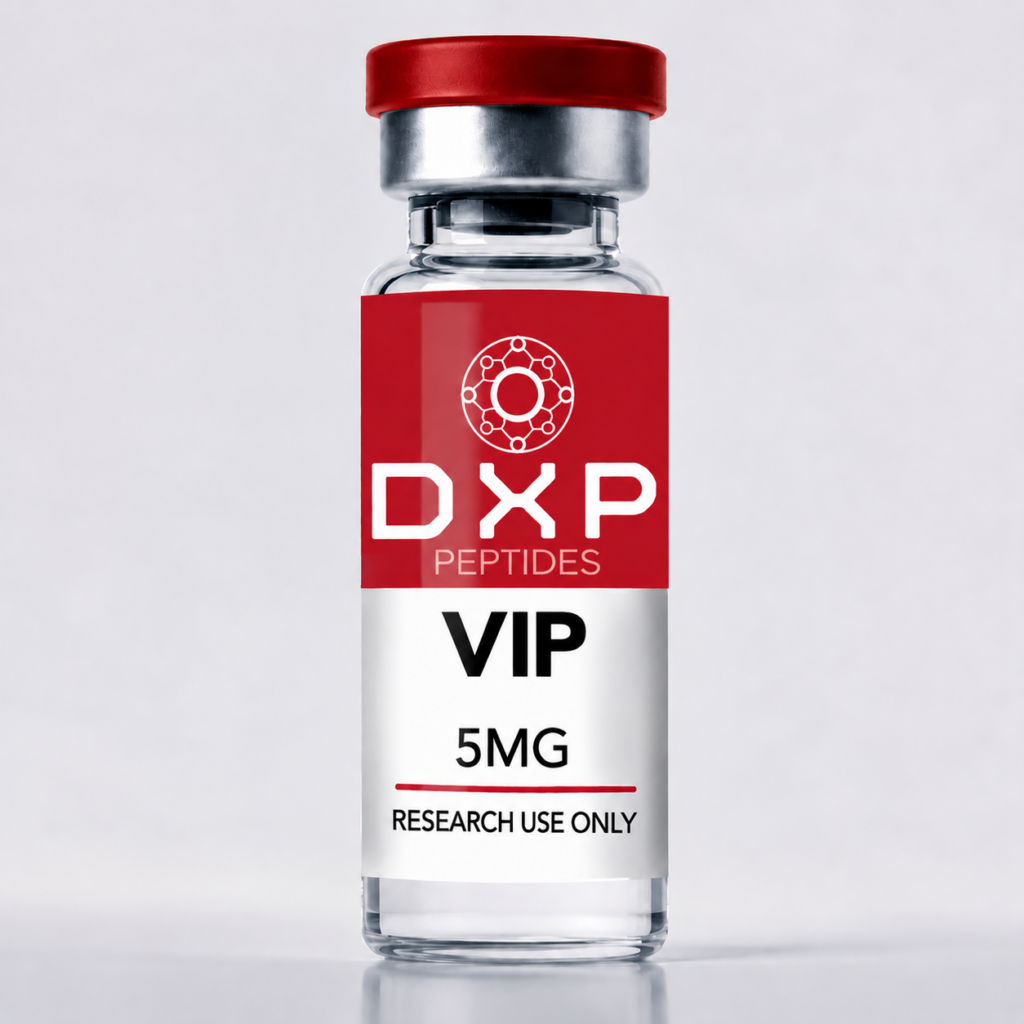
Immune Modulation & Defense
VIP
Synthetic Neuropeptide Analogue
Research Use Only — Not For Human Consumption
Product Description
Overview
Vasoactive Intestinal Peptide (VIP) is a 28-amino-acid endogenous neuropeptide found throughout the central and peripheral nervous systems, the gastrointestinal tract, and immune tissues. It belongs to the glucagon/secretin superfamily and acts as a potent signaling molecule in numerous physiological systems.
In laboratory research, VIP is widely recognized for its diverse roles in vasodilation, smooth muscle relaxation, and neuroprotection. It is a critical tool for investigating the modulation of the immune system, particularly in the balancing of Th1/Th2 cytokine responses and the promotion of regulatory T-cell function. Its ability to activate the VPAC1 and VPAC2 receptors makes it a primary focus for studies involving systemic inflammation, pulmonary health, and the “Shoemaker protocol” for Chronic Inflammatory Response Syndrome (CIRS).
Key Research Applications
VIP serves as a high-affinity ligand for G protein-coupled receptors (VPAC1 and VPAC2) to study:
- Pulmonary and Vascular Research: Investigating potent vasodilation mechanisms and smooth muscle relaxation in pulmonary arterial hypertension models.
- Neuroimmune Communication: Researching the “anti-inflammatory” effects of VIP, including the modulation of Th1/Th2 cytokine balance and immune cell migration.
- Gastrointestinal Physiology: Modeling gut motility and intestinal barrier function in inflammatory bowel disease (IBD) research.
- CIRS and Environmental Illness: Experimental investigation into mold-related illness protocols and systemic inflammatory response modulation.
- Circadian Biology: Analysis of VIP’s role in the suprachiasmatic nucleus for the regulation of circadian rhythms.
cAMP Signaling: Studies involving the activation of adenylate cyclase and downstream cyclic AMP-dependent signaling cascades.
Additional Details
- Synonyms: Vasoactive Intestinal Polypeptide, Intestinal Vasodilator Peptide
- Sequence Length: 28 Amino Acids
- Peptide Type: Synthetic Neuropeptide Analogue
Handling & Reconstitution
To maintain the integrity of this 28-amino-acid neuropeptide:
- Reconstitution: Use sterile water or an appropriate buffered aqueous solution.
- Technique: Gently swirl the vial until the powder is fully dissolved. Avoid vigorous agitation, as VIP is sensitive to mechanical stress and temperature fluctuations.
- Stability: Immediately aliquot the solution into single-use portions to avoid repeated freeze-thaw cycles. Store at –20°C or below for long-term stability.
- Sterilization: If required for cell-based assays, filter sterilize (0.22 µm) before use.
Important Safety Information
For Research Use Only. This product is a synthetic neuropeptide intended strictly for laboratory and in-vitro research. It is not for human or veterinary use, nor is it intended for diagnostic, therapeutic, or clinical applications. Researchers should note that experimental molecular effects are highly dependent on receptor expression and concentration within the specific model utilized.
References
- Said S.I., Mutt V. Polypeptide with broad biological activity: isolation from small intestine. Science, 1970; 169(3951): 1217–1218. DOI: 10.1126/science.169.3951.1217
- Harmar A.J., Arimura A., Gozes I., et al. International Union of Pharmacology. XVIII. Nomenclature of receptors for vasoactive intestinal peptide and pituitary adenylate cyclase-activating polypeptide. Pharmacological Reviews, 1998; 50(2): 265–270. PMID: 9647867. https://pubmed.ncbi.nlm.nih.gov/9647867/
- Delgado M., Pozo D., Ganea D. The significance of vasoactive intestinal peptide in immunomodulation. Pharmacological Reviews, 2004; 56(2): 249–290. PMID: 15169929. https://pubmed.ncbi.nlm.nih.gov/15169929/
Specifications
| Molecular Weight | ~3325.8 g/mol |
|---|---|
| Purity | ≥99% (HPLC Tested) |
| Form | White to off-white lyophilized powder |
| Storage | Store desiccated at –20°C (Protect from light) |
| SKU | DEXA-VIP |